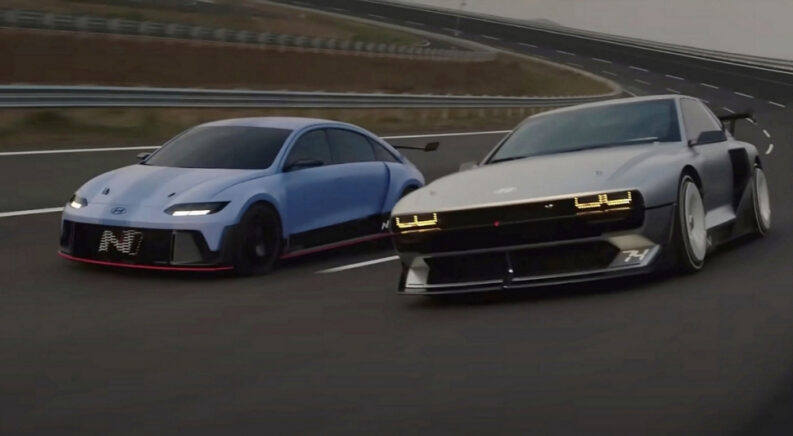
By some estimates, nearly 99% of concept cars never evolve into full production models. But they still serve an important purpose in the design, development, and marketing process. A concept car allows an automaker to test new technology, generate buzz, and gauge the market’s interest in forthcoming products. That’s especially true of the new N Vision 74, which Hyundai actually describes as a “rolling lab.” That’s no exaggeration, as the N Vision 74 has allowed the brand to experiment with a cutting-edge hydrogen fuel-cell/EV powertrain, a new “virtual differential,” and other emerging technologies.
The N Vision 74 is the latest creation from the mad scientists at Hyundai’s N sub-brand, and it could make the jump from concept car to full-on production model as soon as mid-2026. Named after both Hyundai’s Global Research and Development Center and Germany’s famed Nürburgring racetrack, the N division has been pumping out both high-performance takes on existing Hyundai models since 2016. The Hyundai IONIQ 5 N is a standout in the high-performance crossover segment, with 641 hp and a zero-to-60-mph time of just 3.0 seconds. The Elantra N provides a thrilling gas-powered experience with its own 4.8-second sprint time. However, it’s the IONIQ 6 N that really sets the stage for the new Hyundai N Vision 74.
The midsize IONIQ 6 N sedan posts an equally impressive zero-to-60 time of around 3.0 seconds and, like the IONIQ 5 N, can temporarily up its output thanks to a novel N Grin Boost feature that adds 40 ponies to the equation. It’s a compelling resume, but it’s no match for the N division’s first homegrown creation in the N Vision 74. Let’s track the evolution of this intriguing concept model, explore the advantages of fuel cell technology, and learn if and when the Hyundai N Vision 74 might arrive at a dealership near you.
Back to the Future
The N Vision 74’s name references an important date in Hyundai history. 1974 was the year the Hyundai Pony Coupe concept car debuted at the Turin Motor Show. While a Pony hatchback eventually enjoyed a full production run from 1975 to 1990, the coupe was noticeably absent from the market. The concept model earned plenty of attention on the auto show circuit, but Hyundai ultimately lacked the high-performance components to do the design justice.
Designed by Giorgetto Giugiaro, the Pony Coupe’s original blueprint would serve as the basis for one of the 1980’s most famous vehicles. Take one look at the N Vision 74’s metallic paint job, its “folded paper” angular body, and sporty proportions, and you’ll quickly be transported right back to the future. Giugiaro’s prolific career includes stints with most of Europe’s major brands and legendary models such as the Volkswagen Golf Mk1 and the Lotus Esprit. However, it’s the DeLorean DMC-12 that stands as the designer’s most recognizable creation. Aside from the gullwing doors and ability to transcend linear time, the Pony Coupe concept is eerily similar to Doc Brown’s time-traveling ride, albeit with some important modern updates.
The original Pony Coupe inspired Hyundai’s Executive Vice President of Design SangYup Lee to produce some early N Vision 74 sketches as far back as 2016, and the concept car finally made its debut at Hyundai’s N Day 2022. Designed to broadcast Hyundai’s high-performance intentions to the world, the N Day event served as the coming-out party for the IONIQ 5 N and 6 N and a standalone concept model in the N Vision 74. The N Vision 74 concept was what Hyundai described as a “rolling lab” test bed. Not quite a dedicated racing rig, not quite a full production model, the “rolling lab” approach allows the brand to test new and emerging technology in a relatively low-stakes environment. The original concept version was a 671-hp, mid-engine hydrogen fuel-cell/electric hybrid sports car with a reported zero-to-60-mph time of just under 4.0 seconds and an all-electric range of 315 miles.
A 62.4-kWh battery pack powers a dual-motor setup while an 85-kW hydrogen fuel cell produces a little extra juice to extend the car’s range. Simply pop into a hydrogen fueling station, and you’ll be back on the road before you know it, with the fuel cells topping off the EV battery as you motor down the highway. This fuel cell tech is dramatically lighter than the components required for a traditional EV system, allowing the concept car to offer miles upon miles of emissions-free driving. These systems haven’t achieved much in the way of mainstream success, but the technology has proven itself under the hood of models like the Toyota Mirai, BMW iX5, and Honda CR-V FCEV. The N Vision 74 also features all the aero elements one would expect from a high-performance model, along with some upsized air intakes designed to keep everything nice and cool.
Details of the N Vision 74 ‘s genesis were further filled in during another N day event at Germany’s Bilster Berg track. It was there that former Hyundai-Kia R&D chief Albert Biermann spilled the beans on the concept model’s underpinnings. “It’s a [Kia] Stinger,” he told Autocar. “The design came much later – and the whole idea started with a different brand. It wasn’t an N thing at all, it was for the luxury brand [Genesis].”
Kia’s midsize fastback fit the bill in terms of size, but was gutted to make room for new tech and ambitious ideas. The Stinger-derived body is just one example of the group effort that is the N Vision 74. The prototype’s electrical system and traction motors are based on the E-GMP platform used by the IONIQ 5 N and 6 N, the fuel cell and hydrogen storage system were taken from the Hyundai Nexo, and some body elements were borrowed from the Genesis G70.
Realizing the Vision
When is the N Vision 74 going to hit the streets, and what will it look like in its final, production-ready form? The first question is the easier of the two, so we’ll start there. The N Vision 74 can be ordered directly from Hyundai’s website for just $150. Unfortunately, that’s just the 1:18 scale resin model, which could be a tight fit for most drivers. The genuine article could take a bit longer, and while Hyundai execs announced a 2030 deadline at a recent investor meeting, there have been rumors of a mid-2026 release.
Recent spy shots and press events indicate that the N Vision 74’s look hasn’t dramatically changed since the concept model debuted in 2022. The car’s unique facade employs the same “Parametric Pixel” design language as the IONIQ models, but takes a bolder approach with a retro-futuristic look defined by its sharp angles, white hubcaps, and advanced pixel LED headlights. The same can’t be said of the N Vision 74’s performance specs, which look to have improved over the last few years. The car will now produce around 800 hp, a 120-hp improvement over the original, and boasts a 3.0-second zero-to-60-mph time. Its range is said to have improved to some 370 miles.
Most importantly, the N Vision 74 appears to retain its hydrogen fuel cell system. This wasn’t a certainty, as the niche powertrain presents its fair share of design challenges, not to mention practical issues tied to limited refueling infrastructure. Ditching the ambitious fuel cell design in favor of the all-electric approach would have made production a whole lot easier, but the addition of a larger battery pack threatened to throw the car’s delicate power-to-weight ratio right out of balance. Hyundai seems to be welcoming the challenge, sticking to its fuel cell guns to produce one of the most compelling models in recent memory.
The task is made a little easier thanks to the fact that the N Vision 74 will see a limited production run, though that number also seems to be shifting. While initial reports suggested that only 100 units would be produced, one recent article put the number closer to 200. The mix of street vs track cars also varies, with one article suggesting that, contrary to initial reports, most models could be reserved for racing, while the remaining units will only be available on an invite-only basis. That’s the first bit of bad news, but it doesn’t stop there.
The forthcoming supercar comes with a price to match, with estimates ranging from $250,000 to $350,000. That’s a significant chunk of change by any measure, and will dramatically limit the car’s customer base. So will the fact that only two U.S. states actually have retail hydrogen fuel-cell refueling stations. The technology is a little more practical in California, which leads the way with 54 retail stations. Hawaii has one, and while a few other states have them, they are not sold for retail. In all honesty, this might not limit the N Vision 74’s apples as much as one might think. The supercar isn’t exactly primed to serve as a daily driver, so concerns around refueling, extended road trips, and other typical automotive activities are a little less relevant.
Regardless of its availability, price, and practicality, the N Vision 74 serves as an important bellwether for Hyundai’s alternative-fuel intentions and high-performance craftsmanship. If the N Vision 74 can prove itself in real-world conditions, such fuel cell/EV-powered vehicles could become a more practical option in the eyes of the average driver. The coupe also gives the automaker a chance to set itself apart in a crowded performance segment that’s recently been dominated by all-electric models and legitimize the N sub-brand amongst the market’s more thrill-seeking buyers. One thing for sure is that the Hyundai N Vision 74’s retro-inspired design is sure to turn some heads faster than you can say “1.21 gigawatts.”