Some cars are background noise, others are main characters, and then there’s the Subaru Baja. The Baja feels less like a vehicle and more like a deleted scene from a cult movie that somehow became canon anyway. If it were a character, it wouldn’t be the predictable hero, but the oddball everyone underestimates and then quietly steals the show. Think Han Solo energy in a world full of protocol droids.
Here we are years after its disappearance, asking whether Subaru should bring back the Baja, or was it a one-season wonder that’s better left in the vault? It’s time to pop the hood on that idea and confront a truth enthusiasts already know. The Baja didn’t miss the moment. It created one, just a little too early.
The Indie Film of Trucks
When the Baja dropped in 2002 at the North American International Auto Show, it landed with all the subtlety of a plot twist in Fight Club. The timing was peak early-2000s chaos. Flip phones snapped shut like punctuation. Velour tracksuits were entire personalities. CD binders had more square footage than some studio apartments. It was the strange, shimmering bridge between analog and digital life. It was an era where sitcom favorites like Friends coexisted with the rise of reality TV spectacles like The Osbournes, Fear Factor, and American Idol.
In hindsight, the Baja should’ve fit right in with the anything-goes, the weirder-the-better energy of the new millennium. Instead of being embraced, it was met with confusion, like dropping The Big Lebowski into theaters and expecting everyone to understand The Dude. It was the Donnie Darko of trucks, critically fascinating, slightly misunderstood, and quietly building a cult following. The Baja wasn’t wrong. It was just speaking a language the market hadn’t yet learned.
The Outback-Turned-Truck
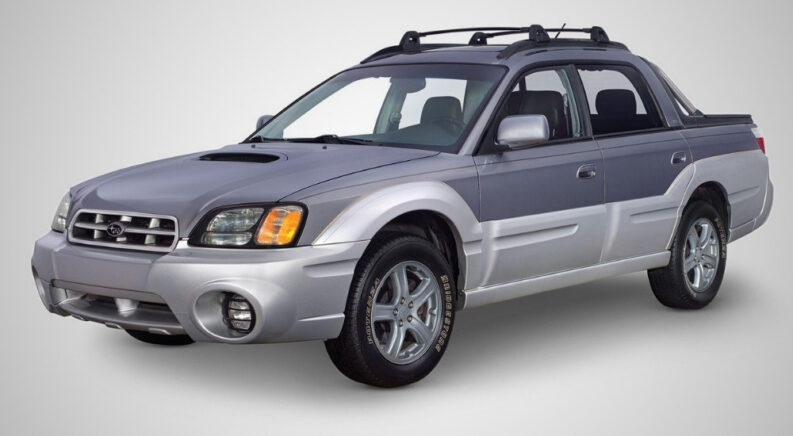
At a glance, the Baja feels oddly familiar, almost like a prototype for modern-day lifestyle trucks like the Hyundai Santa Cruz, Honda Ridgeline, and Ford Maverick. The truth is, the Baja was essentially the prototype. Using the Outback platform as the Baja’s foundation, Subaru added six inches to the frame. The automaker took a few liberties with the cargo area by carving the rear into an open bed that, unlike the Brat, kept the rear seats facing forward and, an important and crucial detail, inside the cabin this time.
The Baja also introduced another clever trick: a pass-through cargo system that, like the Baja’s styling, is remarkably familiar in the current landscape. The idea was to maximize the Baja’s versatility, with a Switchback design stretching its capacity to haul items up to 7.5 feet long. Subaru’s willingness to think outside the box and its unique interpretation of “funky” have never been in question. In fact, “funky” is how the Baja’s lead designer, Peter Tenn, described his weird and wacky masterpiece in 2002. Unfortunately, the Baja’s timing was the issue.
Oh, the Irony
Subaru marketed the Baja as a “multiple-choice vehicle.” It was a little bit truck, a little bit wagon, and a little bit “why not both?” It was genre-bending before that became a marketing buzzword. In 2003, Subaru doubled down on the Baja concept and added more options to the lineup. The Baja Sport was the stripped-down, no-nonsense version, while the Baja Turbo was the enthusiast pick, with a turbocharged heartbeat and a bit more attitude, like a WRX pickup truck.
Here’s where the irony kicks in. For Subaru, 2003 was the most financially successful year in company history, but the Baja wasn’t the star of that show. Despite Subaru’s confidence in the Baja, buyers weren’t biting. The Baja’s identity, so clear to enthusiasts now, felt blurry to mainstream shoppers at the time. It wasn’t rugged enough for traditional truck buyers. It wasn’t conventional enough for SUV and wagon loyalists. It existed in a space that didn’t yet fully exist. It existed for another generation of drivers, becoming the automotive equivalent of a box-office flop like Scott Pilgrim vs. the World, which needed time and the right audience to resonate.
The Muse for Modern Day Marvels
Now, look at today’s landscape. The Ford Maverick is selling like limited-edition sneakers, with over 155,000 models sold in 2025. The Honda Ridgeline proudly embraces its versatility, practicality, and the brand’s reliability like the underdog in every popular sports flick that makes it to the silver screen. The Hyundai Santa Cruz leans confidently into its identity, like a character who’s finally figured out their arc.
Drivers turn to these trucks for their lifestyle-based design. In other words, the Maverick, Ridgeline, and Santa Cruz are living in the exact space the Baja sketched out years ago in 2002. Subaru didn’t miss the trend. They dropped the pilot episode before the binge era.
Building the Case for Its Return
A Baja revival wouldn’t be a stretch. It would feel more like a long-awaited sequel. If done right, its return could veer away from a “direct-to-DVD” release and earn bragging rights as a box office hit like Top Gun: Maverick. Go ahead, “Talk to me, Goose.”
The Baja Fan Club
The Baja already has a built-in fan club. Modern Subaru owners are in on the joke, the secret, the plot twist. Crosstrek, Forester, and Outback drivers are living a lifestyle that feels like a montage set to “Dog Days are Over” by Florence + The Machine. It’s early mornings, muddy trails, and gear piled high around the palpable excitement of what’s ahead. It’s the panting dog in the backseat, the hurriedly packed camping gear for a last-minute getaway with friends, and a center console packed with protein bars, sunscreen, electrolyte packs, and Chapstick. This is a community that doesn’t want or need a massive truck. It’s an audience who wants something that fits their life without adding hassle or turning every mile into a gas-guzzling trek that threatens their adventure funds.
What It Could Be
A modern-day Baja isn’t such a wild idea in the current landscape. Subaru doesn’t have to reinvent the wheel. It just needs to sharpen a design that was once ahead of its time and leverage the brand’s DNA for capability and reliability. Cue the thought-provoking soundtrack and dream with me for a minute.
A modern-day Baja would be fully unlocked and built wild. It wouldn’t be cosplay rugged, but it would have actual capability that invites dirt rather than avoiding it. Give it enough turbocharged power to make backroads feel cinematic. We’re not talking Fast & Furious levels of chaos, but the ability to confidently handle changing landscapes and seasons. Build the Baja with a modular bed that can handle bikes, boards, and bulky items, the outliers of the gear realm that don’t fit neatly into boxes or bags. Entice drivers with an efficient hybrid that doesn’t compromise the Baja’s penchant for adventure. Offer quiet confidence instead of a loud, fuel-consuming compromise. This wouldn’t just be a Baja comeback. It would be a glow-up.
The Final Take
The market is ready. The audience exists. The segment is thriving. Subaru already wrote the first chapter. The Baja wasn’t chasing a trend. It predicted one. Bringing it back now wouldn’t be an imitation, but a sequel that finally lands, if done right.
Will Subaru bring it back? If they want safe and predictable, no. But if they want something with personality, unapologetic weirdness, and just enough unpredictability to get people’s attention? Then the answer is yes. Bring it back. Let it be weird. Let it stand out. The world finally understands the Baja. This time, it might just be the sequel it deserves.