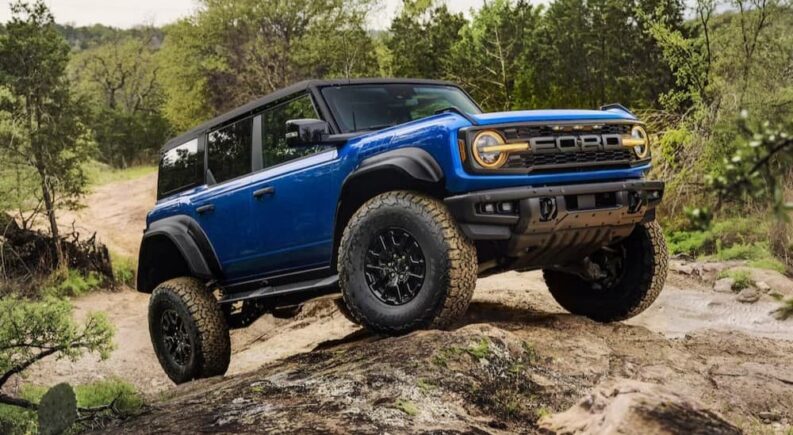
Ford has certainly developed a knack for names when it comes to off-road technology. The brand’s GOAT Mode (Goes Over Any Terrain) is one obvious example. But it’s Ford’s available heavy-duty suspension system that really gives the Bronco and Bronco Sport an edge in off-road scenarios. The HOSS (High-Performance Off-Road Stability Suspension) system is perfect for galloping across challenging off-road terrain, and it goes a long way towards enhancing the adventure-ready credentials of Ford’s newest SUVs
While the HOSS system opens the door to a wide world of off-road antics, the real performance potential of the Bronco and Bronco Sport all depends on which version you choose. Ford offers four different takes on the HOSS system, ranging from HOSS 1.0, 2.0, and 3.0, to a no-holds-barred 4.0 version that’s limited to the range-topping Bronco Raptor. Let’s explore each one and learn how the right suspension can make all the difference in finding success on the (off) road less traveled.
A Quick Suspension Refresher
Before we dive into the specifics of the HOSS system, we should take a moment to explain why suspension is so important for off-road performance. Though often thought of as a comfort-enhancing feature, suspension can actually have a huge impact on performance and control when you venture off the pavement.
The suspension is designed to ensure a vehicle’s tires make consistent contact with the ground. This is one of the best ways to ensure traction, steering control, and stability, especially when encountering the type of rough, uneven terrain found in many off-road locales. A good suspension can effectively soak up the bumps, ruts, and obstacles that come with off-road driving while keeping the driver from being bounced around the cabin.
The suspension isn’t a single part but rather a constellation of components that work in tandem to deliver a more enjoyable and safer off-road experience. We won’t get into every nut and bolt, but some of the primary suspension components include:
Axle: Responsible for delivering power to the wheels, the axle also plays an important role in supporting the vehicle’s weight and withstanding the abuse of off-road use. An upsized axle is a common feature of many off-road models, providing the strength necessary to handle larger tires, increased torque, and the added stress of locking differentials.
Steering Rack: While technically part of the steering system, the steering rack can have a huge impact on off-road performance. When you’re cruising through the city on paved roads, it doesn’t take much effort to maneuver the vehicle. It’s a whole different story when you venture off the beaten path. A rough, rutted trail can strain a standard system, but a steering rack engineered for off-road conditions offers a much more durable alternative while providing greater control and precision.
Springs: Springs are one of the more self-explanatory aspects of a suspension setup. By allowing the wheels to move up and down, these springs help keep a vehicle level, even over bumpy stretches of trail. These springs generally come in two forms: leaf springs and coil springs. While leaf springs are great for overlanding and certain heavy-duty applications, Ford has designed the Bronco and Bronco Sport around a set of coil springs that are ideal for aggressive off-road driving.
Dampers: Dampers, also known as shock absorbers, do just what the name suggests. The springs are responsible for soaking up most of the bumps in the road, but the dampers play an important role in reducing the compression and rebound associated with aggressive off-road use. The Bronco employs a long-travel front suspension with coil-over dampers, while the Bronco Sport uses a MacPherson strut front suspension.
Bump stops: Ford’s off-road models aren’t afraid to catch a little air, and specialized bump stops help the Bronco and Bronco Sport withstand the impact of landing. These bump stops, also known as jounce bumpers, help prevent a vehicle from bottoming out by absorbing the energy before the suspension reaches the end of its travel. This not only has a noticeable impact on comfort but also helps protect your vehicle from long-term damage.
Sway Bars: Sway bars, a.k.a. anti-roll or stabilizer bars, reduce body roll during cornering by connecting the left and right wheels. This is fine in on-road scenarios, but many off-road drivers prefer a little more play to maintain contact between the tires and uneven ground. That’s why Ford has designed the Bronco with an available disconnecting front sway bar that improves both articulation and traction.
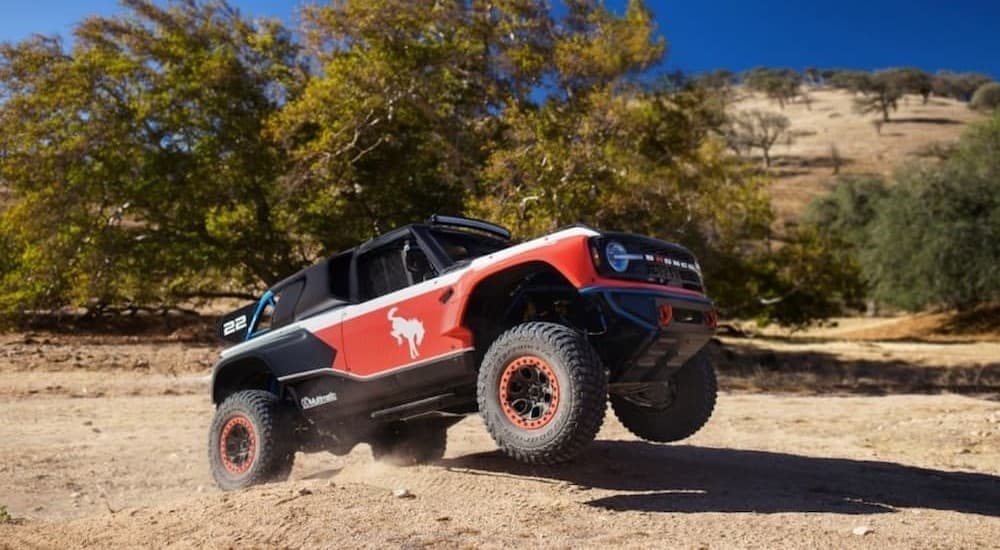
Levels of HOSS
HOSS 1.0
If you’re looking for a perfect combination of off-road performance and on-road comfort, Ford’s HOSS 1.0 setup has you covered. An independent front suspension (IFS) with off-road-tuned springs and dampers gives the Bronco a responsive ride on paved surfaces, but still provides plenty of articulation when you hit the trail.
In the back, you’ll find a solid 220mm rear axle with a five-link design and coil-over springs that allow for up to 215mm of rear suspension travel. Add a set of Hitachi twin-tube shocks with single-zone damping and progressive-rate end-stop control valves to prevent the SUV from bottoming out, and you’ve got the perfect setup for most common off-road applications.
The Bronco Sport can also be optioned with the HOSS 1.0 package, but there’s an important difference between Ford’s two off-road SUVs. While the body-on-frame Bronco can easily accommodate some of the best off-road gear on the market, the crossover-based Bronco Sport is a bit more limited in its customization potential. The Bronco Sport can be paired with the HOSS 1.0, 2.0, and 3.0 systems, but these packages are a little different than what you’ll find on the midsize version. When you opt for the HOSS 1.0 setup, the Bronco Sport doesn’t receive the same heavy-duty axle hardware, though it does gain an off-road-tuned suspension with enhanced springs, dampers, and anti-roll bars.
HOSS 2.0
Spring for one of the Bronco’s upper trims or add the off-road-ready Sasquatch Package, and you can enjoy the full capability of the HOSS 2.0 system. This design represents the most well-rounded option, and might just be the best value of the bunch.
The 220mm solid rear axle is paired with an upsized 210mm front axle. The one-zone damping system is replaced by a three-zone system with Bilstein position-sensitive dampers, external reservoirs, and End Stop Control Valve (ESCV) technology. These position-sensitive Bilstein dampers adjust damping force based on wheel travel, while the external reservoirs increase oil capacity to improve cooling and reduce the shock-fade that can come with intense off-road use
If you’re looking for an even more capable off-road ride, the available Sasquatch package adds 35-inch tires, 17-inch beadlock-capable wheels, electronically locking front and rear axles, and more. The package even includes a lifted suspension and modified fender flares, not to mention a rear stabilizer bar and a new-and-improved steering rack, steering gear, motor, and tie-rod system designed to handle the larger 35-inch wheels.
The Bronco Sport’s own HOSS 2.0 package includes aggressive damper tuning and improved impact absorption, ideal for off-road use. The Bronco Sport also adds stiffer springs, along with all the hardware included in the SUV’s Badlands trim. From Ford’s advanced 4×4 system and twin-clutch rear drive unit to a rear differential lock and GOAT Modes with seven customizable settings, you’ll be able to hit the trail with confidence when you choose the Bronco Sport.
HOSS 3.0
High-speed off-road driving is one of the most demanding activities for any vehicle. Cruising over rough terrain is hard enough when you’re moving at typical trail speeds, but even the smallest obstacle can become a big issue when you’re tearing through a hard-packed desert at 50 mph.
HOSS 3.0 includes the same heavy-duty axles as the 2.0 system, as well as a five-zone damping system that allows the vehicle to respond quickly to changing conditions. Nitrogen-charged shocks and piggyback reservoirs improve thermal capacity, prevent fade, and make HOSS 3.0-equipped models uniquely well suited to both on- and off-road driving, but they’re just one part of the system’s considerable appeal.
Upgrade to HOSS 3.0, and you’ll also be able to enjoy 11.5 inches of ground clearance, as well as a severe-duty steering rack lifted straight from the Ford Performance division. Intended to handle increased loads created by aggressive off-road driving and larger tires, the severe-duty steering rack is a major boon to the Bronco’s durability. The system even includes the steering rack motor from Ford’s off-road MVP, the Bronco Raptor. Ford has also increased the suspension’s track width by 25mm for improved stability, and equipped both the two- and four-door models with a rear stabilizer bar.
The highlight of the Bronco Sport’s own HOSS 3.0 package is the Bilstein position-sensitive dampers and revised suspension tuning. It also comes with larger, all-terrain tires, steel skid plates, high-clearance fenders, and a few other extras that make it worth the cost of admission.
HOSS 4.0
Finally, there’s the undisputed boss of the HOSS lineup: HOSS 4.0. Limited to the rarified Bronco Raptor (and entirely absent from the Bronco Sport), this package will have you eagerly eyeing every off-road challenge. The 210mm front axle remains unchanged, but the rear axle has been swapped out for a 235mm solid design that can take a licking and keep on ticking.
That said, the 3.1-inch internal-bypass semi-active Fox shocks with Live Valve technology set the HOSS 4.0 system apart. Fox is already one of the leading names in the world of dampers, but the Live Valve technology takes the suspension to a whole new level by quickly and automatically adjusting to changing terrain.
These shocks make real-time adjustments based on up-to-the-minute telemetry from a complex network of sensors that take readings 500 times per second. By reading metrics such as yaw, roll, suspension position, and speed, the system delivers precise compression and rebound valving to keep everything cool and effective during high-speed off-road travel.
In addition to its cutting-edge Fox shocks, the HOSS 4.0 system is equipped with a unique suspension geometry, frame rails, jounce bumpers, and a rear track bar that keep the rear axle perfectly centered, preventing the vehicle from shifting side to side. The HOSS 4.0-equipped Bronco boasts 13 inches of front wheel travel and 14 inches of rear wheel travel, around a 50% improvement over the base model.
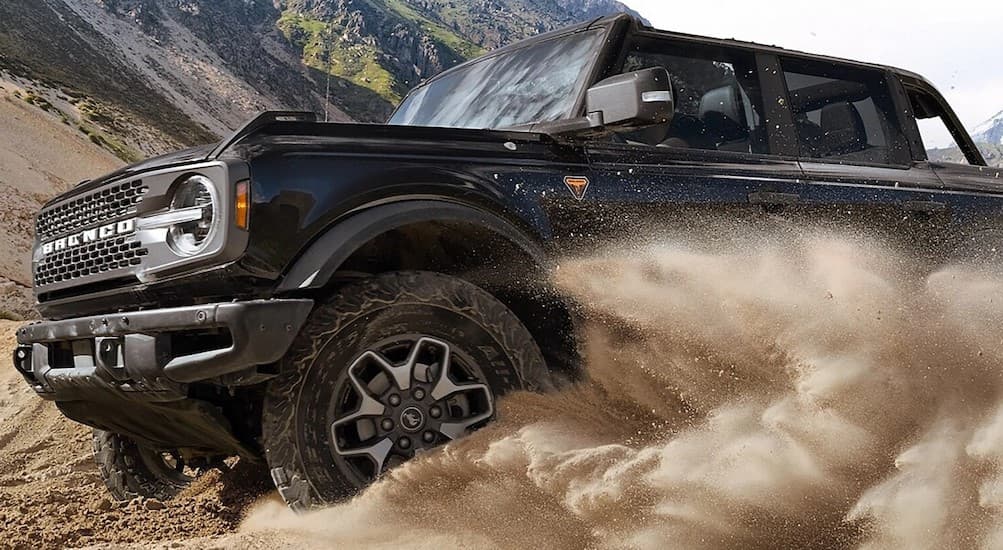
Saddle Up the Ford Bronco and Bronco Sport
There’s no reason to settle for a one-size-fits-all solution when you’re looking to build the off-road rig of your dreams. While some drivers are more concerned with on-road comfort, others put a premium on an SUV that’s ready to take on some of the most challenging terrain that Mother Nature has to offer.
With four distinct packages to choose from, Ford’s HOSS system can easily cater to any driving style. From HOSS 1.0 with its upsized axles and twin-tube shocks to the HOSS 4.0 suite with its Fox 3.1 live valve dampers, heavy-duty axles, and Ford Performance severe-duty steering, Ford makes it easy to dial in your preferred level of off-road performance.
The body-on-frame Bronco is the obvious choice if you’re looking to rule your local off-road trails, and can be optioned with every version of the HOSS system. The Bronco Sport provides a practical alternative that’s distinguished by its efficiency, comfort, and tech-forward interior. No matter which model or suspension setup you choose, you’ll be able to hit the trail with plenty of confidence when you saddle up the Bronco and Bronco Sport.