The auto world is full of misconceptions. From outdated advice about oil change intervals and warming up your vehicle on a cold morning to the unreliability of turbocharged engines and anti-FWD propaganda, drivers often operate under some bad assumptions. Here’s one that we’ll nip right in the bud. While it’s true that a high-end performance model can deliver an edge-of-your-seat driving experience, you don’t have to drop some big bucks in order to enjoy an engaging, responsive ride that’ll have you looking forward to every commute.
The modern auto market is full of affordable performance sedans that let drivers add a little pep to their daily driving without straining their finances. They’re also surprisingly efficient, employing the latest turbocharger technology to squeeze plenty of fun out of every gallon. From sport-tuned versions of some bestselling models to a standalone performance model that cut its teeth at the highest level of the rally racing world, read on as we explore four affordable performance sedans that won’t break the bank at the dealership or at the gas pump.
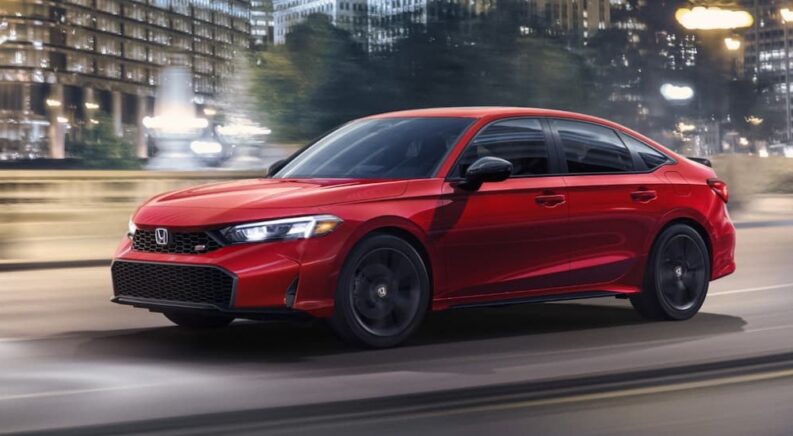
Honda Civic Si
Zero-to-60-mph time: 6.6 seconds
EPA-estimated fuel economy: 31 MPG combined
Horsepower-per-$1,000: 6.47
What happens when you take one of the market’s most popular compacts and equip it with a turbocharged engine, a six-speed manual transmission, upsized brake rotors, and a sport-tuned suspension? You get the Civic Si. Honda has moved nearly 30 million Civics since the sedan first burst onto the scene in the early 1970s.
The Si represents a spicier take on the bestselling formula, allowing budget-conscious buyers to enjoy a driving experience that they won’t soon forget. A 1.5L turbocharged I-4 gives the Civic Si all the muscle it needs for a thrilling ride, with 200 hp on tap, mated to a mandatory six-speed manual transmission. While some drivers are accustomed to rowing their own gears, the mysteries of the manual transmission keep some motorists from enjoying the direct driver-to-car connection it provides.
Honda has engineered around this issue by equipping the 2026 Civic Si with a rev-matching feature that takes all the guesswork out of downshifting. When trying to change into a lower gear on a typical manual model, drivers need to precisely match the engine speed with wheel speed by briefly “blipping” the throttle to reach a higher RPM. The Civic Si’s rev-matching feature dramatically simplifies the technique, using an onboard computer to automatically blip the throttle when you downshift. It’s a big improvement in terms of convenience and goes a long way towards flattening the learning curve associated with a manual transmission.
The Civic Si also features high-performance tires and adjustable sport front seats with additional bolstering that’ll keep you firmly locked in place when you’re aggressively rounding a corner. A limited-slip differential makes all the difference for acceleration, providing plenty of traction and allowing the Civic Si to post an impressive zero-to-60-mph time of just 6.6 seconds.
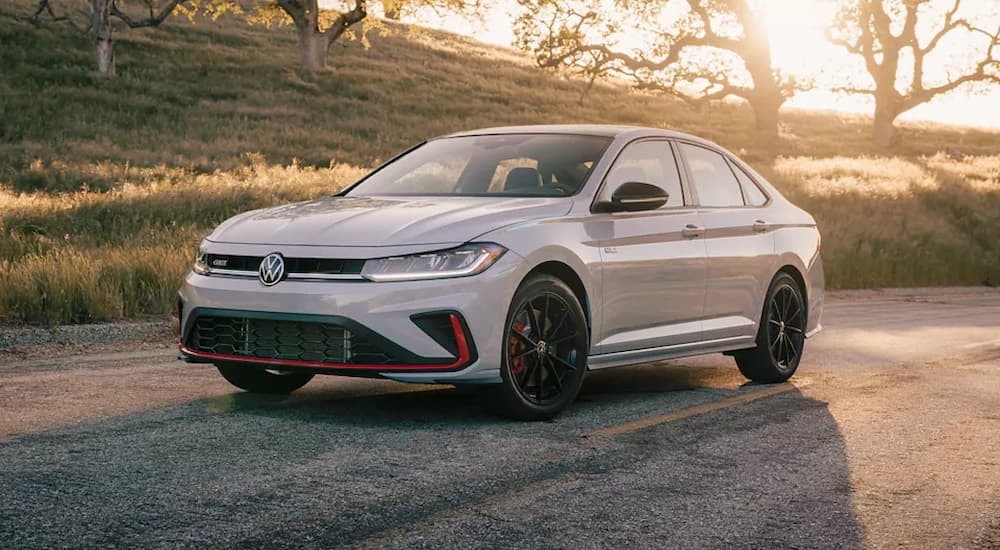
Volkswagen Jetta GLI
Zero-to-60-mph time: 5.6 seconds
EPA-estimated fuel economy: 29 MPG combined
Horsepower-per-$1,000: 6.76
Like the Civic Si, the Volkswagen Jetta GLI sees an established automaker offering a souped-up version of one of its most popular models. The Jetta GLI, or “Grand Luxury Injection,” is named after the potent 2.0L turbocharged, fuel-injected engine, which produces 228 hp and 258 lb-ft of torque.
The Jetta GLI is offered in just one trim, but it’s a compelling one that’s very name speaks to the sedan’s performance potential. Named after the famed German highway that often lacks a speed limit, the Jetta GLI Autobahn is notable for just how well-rounded it is.
The compact delivers an edge-of-your-seat driving experience with its sport-tuned suspension and adaptive damping, enhanced brakes, and a sprint from 0 to 60 mph in 5.6 seconds. It’s also surprisingly well-equipped given its relatively low starting price. From an interior ambient lighting system and heated and ventilated front sport seats to a panoramic sunroof, leather upholstery, a 10.25-inch digital instrument panel, and a suite of advanced driver-assistance systems (ADAS), including adaptive cruise control and Highway Driving Assist, the performance compact provides plenty of value and a refreshing, upscale experience.
The Jetta GLI ditched its six-speed manual transmission with the debut of the 2027 model, but fear not. A seven-speed dual-clutch automatic (DCT) provides a strikingly similar experience without the nerve-wracking trial-and-error that comes with a traditional manual. The DCT is built around a pair of paddle shifters that allow drivers to exert a little more control over the process. Simply flick the left or right paddle to request a shift, and the Jetta GLI will do the rest, quickly shifting gears to prevent a loss of power and giving drivers the chance to forge a closer connection with their vehicle. In addition to its considerable performance benefits, the DTC also enhances the VW’s fuel economy, with the Jetta offering an EPA-estimated 36 MPG on the highway.
Hyundai Elantra N
Zero-to-60-mph time: 4.8 seconds (automatic), 6.1 seconds (manual)
EPA-estimated fuel economy: 24 MPG combined
Horsepower-per-$1,000: 7.86
The Hyundai Elantra N makes its high-performance intentions known the moment you turn the engine over. The sedan’s 2.0L turbocharged I-4 might match the Jetta GLI’s dimensions, but Hyundai has managed to squeeze impressive power from the design, with the Elantra N offering 276 hp and 289 lb-ft of torque. That’s some impressive output by any measure, but it’s particularly noteworthy in a compact that retails for just over $35,000.
In addition to its enticing engine, Hyundai offers drivers two transmission options. The Elantra N usually routes its power through a six-speed manual gearbox, but the brand also offers an eight-speed dual-clutch automatic (DCT) for an added fee. No matter which transmission you choose, you’ll never risk boredom with this compact.
While some drivers will accept no substitute for a good, old-fashioned manual in their performance sedan, the Elantra N’s eight-speed DCT is tough to ignore. The automatic mimics much of what there is to love about the manual, but leverages advanced technology to enable lightning-quick shifts that make all the difference in acceleration. While the manual takes around 6.1 seconds to accelerate from zero to 60 mph, the DCT allows the Hyundai to reach the same speed in 4.8 seconds.
The Elantra N even includes a launch control feature to ensure a speedy start. If you’re looking for a temporary power boost, the car’s N Grin Shift (NGS) push-to-pass feature does just what the name implies, plastering a smile on your face as you’re treated to a 20-second burst of extra power and faster gear changes thanks to increased turbo boost pressure.
Tested on the iconic Nürburgring track, the Elantra N has all the high-performance components needed to earn a checkered flag, including a variable sport exhaust, electronically controlled limited-slip differential, 19-inch alloy wheels with high-performance summer tires, and more. Advanced ADAS are par for the course, but the Hyundai’s wireless smartphone charging pad, Bose premium sound system, and integrated navigation system give the Elantra N an edge over some of its more spartan rivals.
Subaru WRX
Zero-to-60-mph time: 5.4 seconds (CVT), 5.6 seconds (manual)
EPA-estimated fuel economy: 22 MPG combined
Horsepower-per-$1,000: 8.36
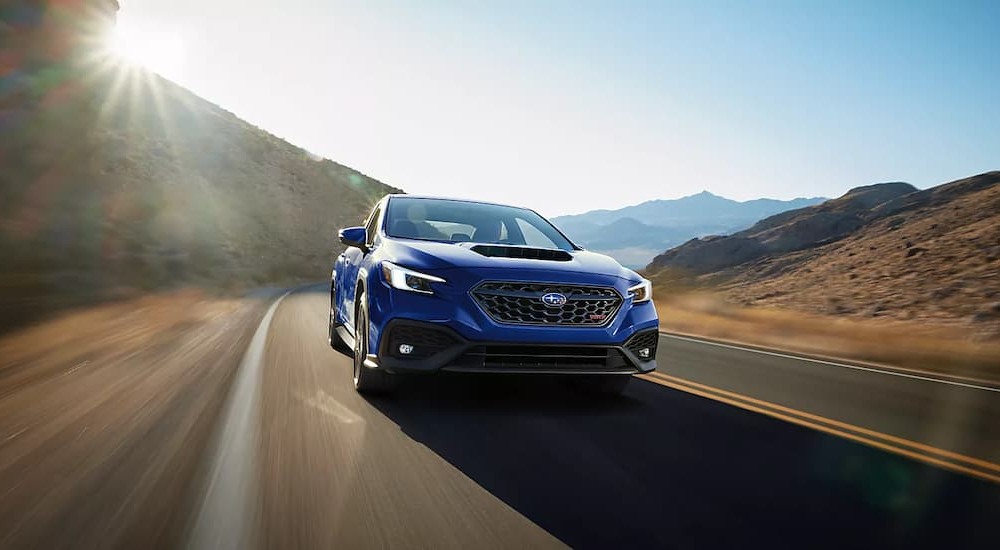
That brings us to the undisputed champion of the affordable performance sedan segment. The Subaru WRX started off as a standard Impreza that was tuned with the World Rally Championship podium in mind. In fact, the compact’s very name is inspired by the professional rally series (WRX stands for “World Rally eXperimental”), where it’s found so much success over the years.
The original Impreza WRX earned Subaru three consecutive manufacturers’ championships in the mid-90s, a first for a Japanese automaker. From the dusty tracks of the WRC to the grueling automotive endurance test that is the 24-hour Nurburgring race, the WRX has yet to encounter a challenge it can’t handle.
The street-legal version of the WRX has been winning hearts and minds for more than 30 years, but dropped the Impreza name to simply become the WRX back in 2015. The current fourth-generation WRX follows a distinctly different formula from the other performance sedans on our list.
First off, there’s the powertrain. While the Honda, Hyundai, and Volkswagen models are all built around a front-wheel drive setup that provides predictable handling and strong traction while reducing weight, the WRX opts for an all-wheel drive setup that’s hard to beat. The only downside comes at the gas pump, with the WRX among the list’s thirstier options at 22 MPG combined.
The AWD approach is something of a hallmark for Subaru, and has long made the Japanese brand the go-to choice for those who frequently venture off the beaten path. It also pays dividends in performance, giving the WRX the high-octane, go-anywhere attitude that earned it so much recognition on the WRC circuit.
The WRX tops out at 271 hp and 258 lb-ft of torque, which puts it closely behind the Hyundai Elantra N. That said, the Subaru’s AWD design gives it a distinct edge in transferring power to the pavement, providing plenty of traction and giving drivers an extra boost of confidence when encountering challenging weather conditions or tough terrain. The rally-inspired sedan can hit 60 mph in 5.6 seconds with the manual, but the optional continuously variable transmission (CVT) is the faster option at 5.4 seconds.
The GT trim includes the CVT as standard, but the tS model is tough to ignore if you really want to ratchet up the excitement. Tuned by Subaru’s in-house Subaru Tecnica International (STI) performance division, the tS includes 19-inch wheels with summer performance tires, adaptive suspension dampers, Brembo brakes, Recaro seats, and more. If you’re looking to turn some heads as you cruise around town, the Series.Yellow trim is styled around an exclusive Sunrise Yellow paint color mirrored in the car’s interior accents, yellow seat bolsters, and yellow stitching.
Don’t Pay a Premium for Performance
These four sedans make one thing clear: performance doesn’t need to come at a premium. Advances in automotive tech have enabled automakers to produce an impressive roster of performance models that are tough to beat in terms of fun per dollar.
While a dedicated sports car or high-performance model can provide plenty of fun, it can also prove to be a less-than-practical choice for everyday driving scenarios. Harsh rides, underequipped cabins, and thirsty engines can make for a challenging experience behind the wheel, and that’s before you factor in the price tag.
Aside from the WRX, these vehicles all benefit from sharing a platform and many standard components with some of their brands’ bestselling models. This goes a long way toward reducing the price and provides buyers with a more sensible ride than your average performance vehicle. If you’re looking to inject a little excitement into your commute, or are seeking a reliable daily driver that can double as a weekend track star, these four models shouldn’t be overlooked.