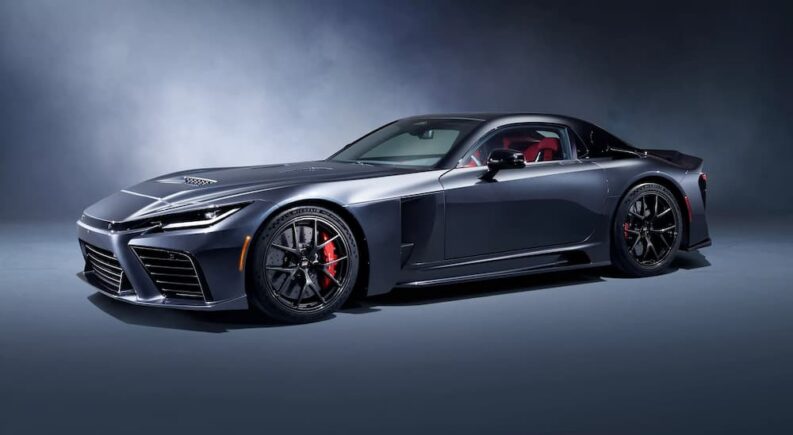
Toyota’s new GR GT is a supercar for the modern age. Slated to debut in 2027, the GR GT is a study in engineering acumen with a hybrid design that promises a sub-3.0-second zero-to-60-mph time and a top speed approaching 200 mph. Designed as a road-legal version of the full-on race car that is the new GR GT3, the consumer model sees Toyota craft a worthy adversary for established supercars like the Ferrari 296 GTB, Mercedes-AMG GT, and the Porsche 911 Turbo S.
The GR GT isn’t just the newest supercar on the block. It also serves as the debut model for the newly independent Gazoo Racing (GR) division. GR is essentially the Tony the Tiger of the high-performance automotive world, imbuing existing models with a little track-ready appeal, crafting homegrown creations that turn “good” into “GR-reat” and providing more pep than a bowl full of sugary cereal. While it was originally tasked with creating high-performance versions of existing Toyota vehicles, GR has since become a standalone brand, like Lexus. In fact, you won’t find any Toyota badging on the GR GT itself, and the model will be sold exclusively through Lexus dealerships. Past Toyota halo models like the 2000GT and Supra have become bona fide cultural phenomena, but can the new GR GT add to the brand’s high-performance legacy? Let’s explore Toyota’s halo car history, pop the hood, and see how it fares against some established European rivals as we fire up the new GR GT.
From Street to Screen
A halo model isn’t just the road-legal version of a legitimate race car. It serves to showcase a brand’s experience and recent advancements in the realm of high-performance engineering. Produced in limited numbers and carrying a high price tag, halo cars are as much a marketing effort as they are a legitimate means of conveyance. Ford, Chevy, and other automakers know that they’re not going to move a significant number of their six-figure models, but regardless of sales, they’ve already fulfilled their main objective by looking good on a poster and generating buzz in online forums.
Toyota boasts a proud history of screen-ready halo cars dating back to the original 2000GT in 1967. The hand-built coupe announced Toyota as a force to be reckoned with in the high-performance segment, and even landed a cameo in the 1967 James Bond film You Only Live Twice. Toyota’s silver-screen superlatives only grew throughout the 1990s and 2000s as its next halo model, the Supra, became a true Hollywood icon thanks to a starring role in the 2001 hit The Fast and the Furious.
Toyota would tap its luxury brand, Lexus, to create its next halo model, the Lexus LFA. While the supercar gave Toyota the chance to showcase its expertise in carbon fiber construction, the LFA had a relatively short run of just 500 units between 2010 and 2012. The Supra returned to the scene after a lengthy 17-year hiatus with the GR Supra making its debut in 2019, but will soon depart to make room for the brand’s newest high-performance offering in the Toyota GR GT.
A GT-Style Supercar
The GR GT might be Toyota’s newest halo car, but that term doesn’t entirely encapsulate the model’s high-performance appeal. If you want to get specific, the new Toyota technically occupies a unique niche between the supercar and GT categories. Like most supercars, the GR GT puts a premium on extreme acceleration and top speed, and isn’t afraid to employ pricey, performance-minded components like carbon-fiber parts, advanced aero elements, and other exotic designs.
While Toyota hasn’t gone whole hog by placing the powerplants behind the driver’s seat with a mid-engine layout like many supercars, the GR GT offers a front mid-engine layout that represents an improvement on your garden-variety vehicle. By placing the engine behind the front axle, a front mid-engine vehicle can offer improved balance and handling, with 45% of the weight balanced in front and 55% in the back. Supercar output tends to hover between 600 and 800 hp, and while the GR GT might occupy the lower end of the spectrum, it certainly qualifies.
The same can be said for the GR GT’s starting price. With the new Toyota expected to retail for around $300,000, there’s no doubting the model’s supercar status from a cost perspective. That said, Toyota’s halo car also takes inspiration from the grand touring segment, which means that the GR GT differs from your typical track-focused supercar in a few key ways. While dedicated supercars might excel on closed tracks, they tend to be a little less practical for everyday use. A supercar that can hug hairpin turns and pull some serious G-forces might inspire some admiration at your local track, but that same car is going to be a lot less comfortable when it comes to long journeys and rush hour traffic jams.
Toyota has split the difference with the GR GT, equipping the car with more comfort-focused tech than your average supercar without losing the high-performance appeal that’s bound to draw so many drivers to the new model. Sure, it might struggle to accommodate your weekly grocery haul with its two-seat design and tiny trunk, but you also won’t feel like some sort of automotive princess and the pea who is personally and painfully forced to experience every bump in the road. The decision to fuse the best aspects of the supercar and GT categories is sure to pay dividends for Toyota and help to broaden the GR GT’s appeal in the performance-minded segment.
Prioritizing Pure Performance
A quick look under the hood proves that the GR GT has all the makings of a true track star. Toyota has pulled out all of the stops to provide the new model with a hybrid powertrain worthy of the supercar designation, and the results speak for themselves. While most of the segment has settled for V6 designs, the new Toyota goes above and beyond with a beefy V8 engine that’ll ensure you’re never hurting for power. Even better, Toyota has paired the V8 with a twin-turbocharger and an electric motor to give the front-engine, rear-wheel drive model all of the muscle you could possibly ask for. The result is that the GR GT can churn out 641 hp, 626 lb-ft of torque, and achieve a top speed of around 199 mph. A rumored 2.9-second zero-to-60-mph time would put the GR GT in the conversation as one of the market’s most enticing supercars, but the engine is just one small part of the Toyota’s appeal.
The Japanese brand has gone to great lengths to help the GR GT cut weight wherever possible, relying on aluminium construction, including forged aluminium control arms, and carbon-fiber-infused body panels to bring the car’s curb weight down to around 3,858 lbs. A quick calculation shows the Toyota achieving a power-to-weight ratio of around 6.01 lbs/hp, which is right in line with what one would expect from a modern supercar. When it’s time to rein in the V8, a set of Brembo carbon-ceramic brakes ensures you’ll be able to keep those 600-plus ponies in check. The brand has also imbued the new GR GT with a performance-focused suspension that goes a long way towards creating a responsive, dynamic driving experience. A double-wishbone suspension in the front and rear provides the GR GT with improved stability and control, reducing body roll and delivering a predictable experience designed to maximize traction. Speaking of traction, you’ll never be hurting for grip with the GR GT’s Michelin Pilot Sport Cup 2 tires, which were designed specifically for Toyota’s newest supercar.
The GR GT reads like a true high-performance model from the word go, especially in its proportions. An elongated hood and cozy cockpit make the new Toyota look like a modern-day Batmobile, minus the hood-mounted missiles, oil slick, and grappling hooks. A massive rear wing speaks to the model’s track-ready intentions, providing all of the downforce you’ll need to keep the tires firmly planted on the asphalt. The car hugs the ground with a total height of just 47 inches, which, when combined with a rear-mounted gearbox and unique driveline, gives the GR GT an exceptionally low center of gravity. The interior reflects the car’s performance ethos with a set of race-ready Recaro bucket seats, a flat-bottom steering wheel, and an impressive roster of premium materials that help to justify the six-figure price tag.
Compared to the Competition
Does Toyota’s new halo car have the necessary credentials to join the small, exclusive club of supercars, or will it be left outside looking in? While the coupe has yet to be put through its paces by drivers who aren’t on the Toyota payroll, some early performance data indicates that the GR GT is more than capable of keeping pace with the segment’s more rarified names.
Widely regarded as the first name in modern supercars, the Porsche 911 Turbo S traces its roots all the way back to the early 1960s. The Porsche has certainly evolved over the decades, starting out with a modest 128-hp 2.0L Boxer engine before evolving into the 3.6L hybrid it is today. As with the Toyota GR GT, a little electrification goes a long way towards boosting the 911’s output, with the Porsche’s electric motors allowing the supercar to achieve 701 hp. These are all important figures to keep in mind, but if there’s one number that really carries some weight in the GT category, it’s a model’s power-to-weight ratio. The Porsche 911 delivers 5.53 lbs/hp, placing it firmly in the middle of the pack compared to similarly priced models.
Next is the Ferrari 296 GTB. The Italian supercar leverages a mid-engine design that significantly ups its performance potential through improved weight distribution, and it’s tough to argue with the results. A hybrid powertrain pairs a 2.9L turbocharged V6 with an electric motor to produce 818 hp, and the Ferrari’s relatively low 3,500-lb curb weight delivers an impressive power-to-weight ratio of 4.27 lbs/hp. The Ferrari also has one more trick up its sleeve. As a plug-in hybrid (PHEV), the 296 GTB can be driven without using the gas tank thanks to a 7.45-kWh battery that provides an all-electric range of around 15 miles.
Then there’s the Mercedes-AMG GT, which is set to see some major changes in the coming year. While the 2026 model employed a hybrid setup that was built around a twin-turbocharged 4.0L V8 and an electric motor, the 2027 version is going all-electric. The 2027 Mercedes-AMG GT EV is said to deliver 1,341 hp from three electric motors. While the German outfit has yet to release specific range data, the fact that the supercar can reportedly add up to 249 miles of range in just five minutes seems encouraging. The 2026 model’s power-to-weight performance works out to around 5.89 lbs/hp, and although the new 2027 EV is considerably more powerful, it’s important to factor in the added weight that comes with the all-electric approach.
A GR-eat Excuse for a Test Drive
The GR GT’s compelling performance specs, eye-catching design, and speedy stats raise an important question: How long until it actually hits the market? Reports indicate a 2027 debut, though a late 2026 arrival isn’t out of the question. Whether you’re a longtime Toyota fan or simply appreciate the feat of automotive engineering that is the new GR GT, the next 11 months are going to feel like an eternity. Of course, a little patience is always helpful when it comes to high-performance vehicles, and the GR GT is no exception. The supercar was originally teased all the way back at the 2022 Tokyo Auto Salon. While it’s been a long four years, we can almost feel the GR GT’s V8 rumble as 2027 inches ever closer. Toyota might typically trade on its reputation for reliability and value, but the GR GT proves that the brand has never lost its penchant for high-performance design.