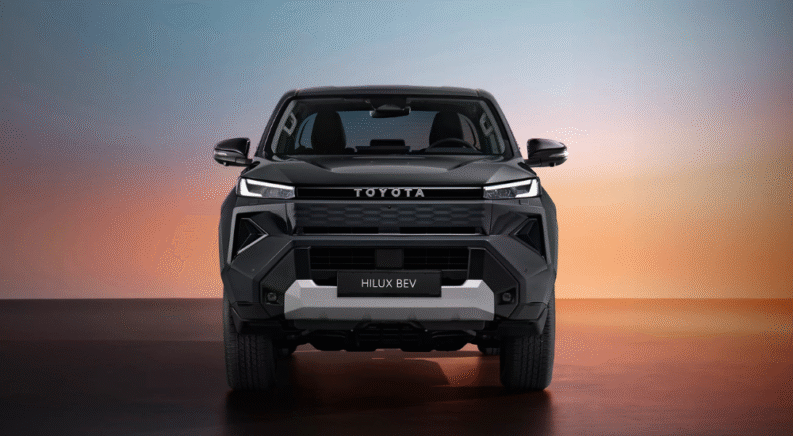
There are certain advantages that come with U.S. citizenship, but the Toyota Hilux isn’t one of them. The legendary pickup has been one of the world’s most popular trucks ever since it first hit the market in 1968, but Americans haven’t been able to access the midsize maestro ever since the U.S. version, creatively dubbed the Toyota Pickup, fled the country in 1995. The Hilux has continued to enjoy strong sales globally and currently ranks as the top-selling pickup truck outside North America. While it’s always risky to mess with that sort of success, Toyota is set to shake things up with an all-electric model designed to give drivers a new, sustainable alternative to their gas-burning truck.
It’s a bold move on Toyota’s part, but the Japanese automaker will hedge its bets by continuing to produce the pickup with internal-combustion (ICE), diesel, and hybrid powertrains that let drivers dial in their preferred blend of performance and efficiency. While the new all-electric Hilux holds a lot of promise, the truth is, Toyota has fallen a bit behind the curve in the current EV truck trend. This is a bit surprising given the brand’s reputation for championing electrically assisted vehicles, but Toyota’s lackadaisical approach is starting to look like a savvy move as slowing sales and general uncertainty continue to rock the segment. The market’s first mainstream all-electric pickup is already reversing course, with Ford recently announcing that the F-150 Lightning will switch from battery-electric to an extended-range electric vehicle (EREV) design that combines the best aspects of hybrid and EV tech. What does the future hold for Toyota’s iconic pickup, and was the brand right to adopt the all-electric approach? We’ll answer those questions and dive into a little Hilux history as we explore the new EV.
A Little Hilux History
U.S. drivers might not be familiar with the Hilux name, but the pickup is one of the longest-running models on the international market. Originally introduced in the late 1960s, the truck’s name implied a luxurious experience that probably wouldn’t pass muster in 2026. While it was a more opulent alternative to more spartan options like Toyota’s Stout pickup with its car-inspired approach to comfort, the Hilux lacked many of the premium materials and advanced tech that define today’s luxury models. Over the years, the truck’s rugged construction, not its comfort or convenience tech, has helped to build the Hilux legend.
The truck is routinely cited for its nearly indestructible design, with even the automotive antagonists at Top Gear failing to best the Hilux. A 2003 episode of the popular U.K. program saw Clarkson, Hammond, and May subject a 1988 Hilux diesel with nearly 200,000 miles to an abusive battery of rigorous stress testing. From braving a beach during high tide to being set on fire and placed on top of a building that was then demolished beneath it, the Hilux took a licking and, rather unbelievably, kept on ticking after being repaired with equipment found in a typical toolbox. The sturdy pickup repeated that success in a 2006 episode, in which a modified 2007 Hilux became the first motor vehicle to complete the journey from Northern Canada to the magnetic North Pole.
That’s a pretty stellar resume by any measure, but it raises the question of why the Hilux hasn’t made its way to the North American market. You’d be hard-pressed to find a country that enjoys a good pickup quite as much as the old U.S. of A., but the Hilux has been conspicuously absent from the market for going on 30 years. The answer is rather obvious when you stop to think about it: chickens. The 1964 Chicken Tax saw the U.S. slap a 25% tariff on all imported light trucks in response to a European tax on American poultry. This tax significantly increased the cost of foreign-made trucks, SUVs, and vans. While it protected U.S. automakers from the harsh realities of the global market, it spelled disaster for brands like Toyota, Volkswagen, and Nissan.
Toyota addressed this issue with a new pickup that would become nothing less than a 4WD sensation. The Tacoma first hit the streets in 1995, and the beloved “Taco” truck has since become the go-to choice for a certain set of adventure-ready drivers who appreciate the value, performance, and reliability that the Toyota offers. The Tacoma introduced its own hybrid model back in 2024 with an i-Force Max that churns out 326 hp and 465 lb-ft of torque. There have also been rumors of an all-electric model coming to market, but it’s a little tough to predict an official debut given the current level of uncertainty in the EV segment.
Embracing the Electric Advantage
The Hilux only gained its own 48-volt hybrid powertrain in early 2025, but Toyota has already returned to the drawing board to update the pickup for the new model year. While details are still a little tough to come by, we do know that the new Hilux EV will be powered by a 59.2-kWh battery driving a unique set of twin electric axles (eAxles) that combine the truck’s electric motors, inverters, and gears into one handy, weight-saving component. The dual-motor design means every Hilux EV will come standard with AWD, an important selling point for any pickup model. That said, the all-electric truck’s 193 hp isn’t exactly earth-shaking, and is honestly closer to what we’d expect from a compact pickup like the Hyundai Santa Cruz or the hybrid version of the Ford Maverick, which both log 191 hp.
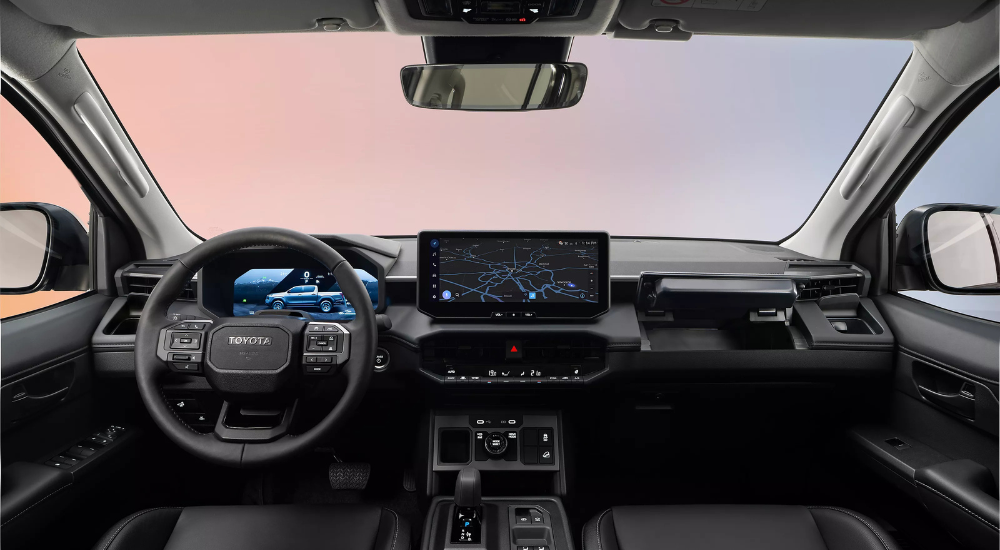
While they might post similar performance stats, the Hilux EV does have one distinct advantage over competitors like the Santa Cruz and Maverick. America’s two compact pickups both employ a crossover construction technique that sacrifices long-term durability, off-road ability, and towing performance for improved comfort and efficiency. The Hilux leverages a traditional body-on-frame approach that’s much better suited to the rigors of the pickup lifestyle, especially in terms of towing. Speaking of pulling power, the Hilux EV is expected to tow up to 3,500 lbs and offer a max payload capacity of 1,500 lbs. Those numbers won’t turn many heads in the gas-powered segment, but they should allow the Hilux to compete with its EV brethren when it comes time to hitch up a small trailer, boat, or RV. The Hilux will feature a robust AWD system with 4Hi and 4Lo settings, as well as Toyota’s acclaimed Multi-Terrain Select (MTS) system. MTS includes dedicated settings that range from Sand, Mud, and Rock to Dirt, Snow, and Auto. A new-for-2025 multi-information display even includes different backgrounds to accompany each mode.
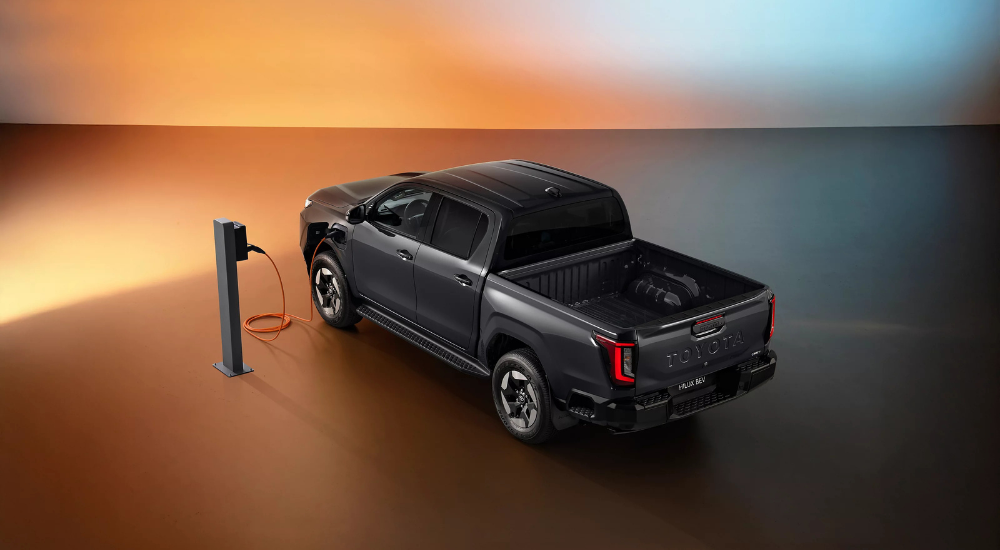
If there’s one drawback to the new Hilux EV, it would have to be its range. The EV’s battery is much smaller than the pack that powers most American models, and it limits the truck’s range to just 149 miles. To make matters worse, that 149-mile figure is based on the WLTP formula used by many European brands. When subjected to the EPA’s own range-measuring algorithm, the Hilux fares even worse at 126 miles, and could see that figure drop even further when payload and towing enter the equation. That falls well below the current U.S. average of 300 miles, and would make the all-electric Hilux a tough sell on the domestic market. The last EV to offer a similarly low range was the Mazda MX-30, which was discontinued after two short years, in large part due to its 130-mile range.
Can We Trust This Toyota?
It’s a bit too early to tell if the Hilux EV will have the intended impact, though it’s hard to imagine the EV model negatively impacting the appeal of one of the world’s most popular pickups. Toyota seems to be playing it safe by keeping the ICE, diesel, and hybrid models around alongside the new EV, which should go a long way towards protecting the brand from any hiccups associated with the all-electric truck.
The Hilux’s smaller-than-average 59.2-kWh battery might have been a sticking point in the U.S., but its 149-mile range is a little easier to explain given the truck’s intended market. While American drivers log around 14,000 miles behind the wheel in any given year, or about 40 miles a day, the rest of the world averages almost half the distance. An EV with 150 miles of all-electric range would be hard to justify in car-centric America, but the Hilux is a much more practical option in countries where denser geography, robust public transportation, and EV charging infrastructure make issues around range anxiety less of a concern.
With 193 hp to its name, the Hilux fails to keep pace with its U.S. rivals, but the truck’s output isn’t bad from a historical perspective. While the average mid-1990s pickup weighed some 30% less than the typical 2025 model, that’s all changed as a “bigger is better” ethos has continued to shape the domestic market. Heavier vehicles require more power to push themselves down the road, and automakers have been happy to oblige, with the average output rocketing from around 160 hp in 1990 to 341 hp in the 2020s. This trend hasn’t been quite as pronounced in the rest of the world, where strict emissions regulations and other restrictions stymie such growth, which is good news for the relatively underpowered Hilux.
Is the Hilux EV ahead of the curve, arriving just on schedule, or a misguided case of “too little, too late” on the part of Toyota? The free market has yet to weigh in, but it seems Toyota might have picked a good time to dip its toes into the pickup EV waters. By taking a slower, more measured approach and tracking consumer trends, Toyota has avoided many of the pitfalls that have plagued competing models. The underwhelming sales performance of the F-150 Lighting has prompted Ford to adjust its EV ambitions, while teaching the rest of the market an important lesson: America isn’t ready to sacrifice performance and utility for efficiency and eco-friendly design when it comes to its pickups. The Toyota Hilux should find plenty of purchase on an international market that’s hungry for EV options. However, a below-average battery and the resulting range could still be a dealbreaker for certain buyers.