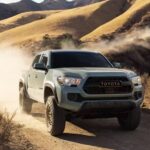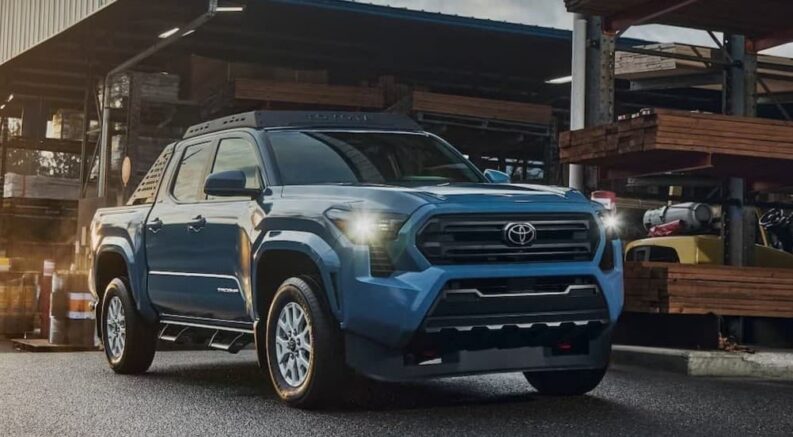
It’s easy to forget that automakers often sell different vehicles overseas than they do in the U.S. But such is the case with Toyota and midsize trucks. While the Tacoma has been Toyota’s midsize pickup in North America and Mexico since 1995 — along with select other areas, such as Costa Rica, Bermuda, and New Caledonia — most of the world receives the Hilux instead. Sometimes stylized as “HiLux,” as its name was originally short for “High Luxury,” this truck has a rich history and is still going strong today. What are the differences between the Tacoma and the Hilux? Why does Toyota dedicate time and resources to two separate midsize trucks? Here’s my investigation into these twin trucks and what they offer owners.
When the Hilux was America’s Truck, Too
Some readers might be too young to remember, but it wasn’t always this way. The Toyota Hilux rolled out in March 1968 as the heir apparent to the Light Stout and Briska. It was sold wherever Toyota sold vehicles, including North America.
For four generations, the Hilux remained Toyota’s sole midsize pickup. It was renamed twice in the U.S., first to the Toyota Pickup in 1976 and then to the Toyota Truck in 1984. However, beneath the nameplate was the same Hilux truck. Here’s a fun fact: The Toyota 4Runner off-road SUV began its life as a station wagon variant of the Hilux,
But in 1992, things changed. Alongside the fifth-generation Hilux, Toyota also introduced the T100 truck. Come 1995, Toyota retired the Hilux from North America and debuted the Tacoma, which was then a compact truck. The T100 continued production until 1998, and the Tacoma — named after the native term for what is now called Mount Rainier — became a midsize pickup in 2004.
What spurred Toyota to create an all-new truck? From what I could find, there are three main reasons that Toyota switched the North American market to the Tacoma. Toyota needed a truck that better fit the needs and demands of North and Central American drivers. These included higher-output engines with gas or hybrid power, more comfortable dynamics for using a truck as a daily driver, and more cabin connectivity and amenities.
The safety, emissions, and technology requirements for U.S. light trucks had diverged significantly from those of other major truck markets. Toyota decided it was easier to design a new truck from the ground up than modify the Hilux to meet those regulations. Also, new, higher tariffs on imported light trucks (yes, tariffs were a thing before 2025) made it more cost-prohibitive to import the Hilux. Current Tacoma trucks are made in Mexico, and many pre-2012 models were made in the U.S., exempting them from most or all tariffs.
Putting the Tacoma and Hilux Head-to-Head
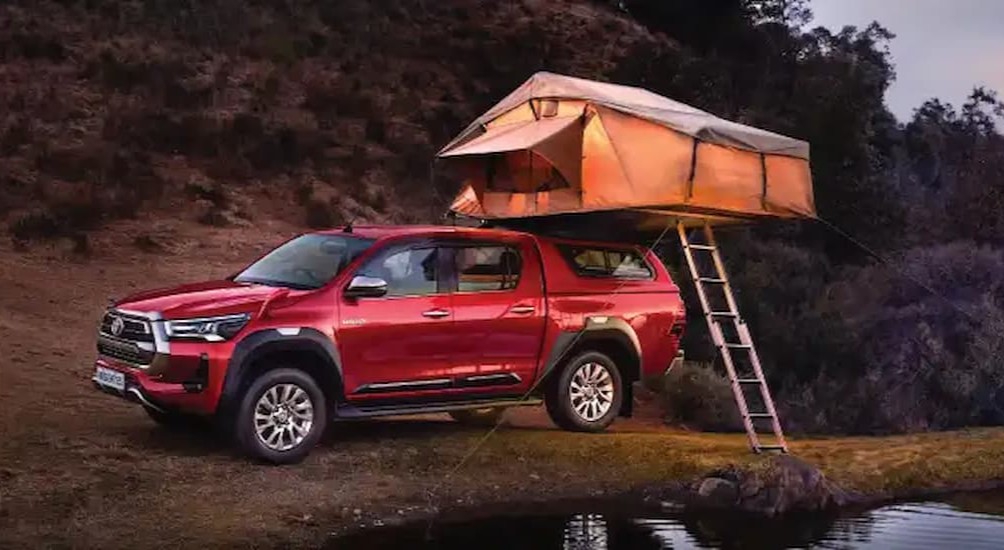
Now that the history lesson is out of the way, it’s time to compare the specs on these trucks. The Hilux entered its ninth generation in 2025, while the Tacoma is on its fourth. That means they’ve each had ample time to evolve and define who they are. Here’s what that means for the powertrains, suspension, and more.
Engines
Since 2024, the Tacoma has offered a choice of three power plants. The base engine is a 2.4L turbocharged I-4. It produces 228 hp and 243 lb-ft of torque on the SR trim, and up to 278 hp and 317 lb-ft of torque on other trims. A hybrid version is also available, which increases output to 326 hp and 465 lb-ft.
The Hilux offers more ways to power up. For decades, the most popular Hilux models have used diesel engines for their excellent low-end torque. The current generation features a 2.8L turbodiesel I-4 that produces 201 hp and 369 lb-ft. A 2.7L gasoline engine produces 161 hp, and Toyota is accelerating production on a Hilux Diesel Hybrid with a 48V electric motor, though I couldn’t find the combined output.
Not only that, but say hello to the battery-electric and fuel-cell-electric versions of the Hilux. The BEV is already available in Western Europe and Thailand, generating 193 hp for a dual-motor AWD system. The FCEV is expected to arrive in 2028.
Capability
Even with America’s reputation for hardworking trucks, the Hilux’s rugged, utilitarian design makes it a strong performer, especially in payload capacity. A diesel Hilux can carry up to 2,238 lbs (1,015 kg) with a regular chassis, and even more with a cab chassis. The gas engine payload reportedly reaches nearly 2,800 lbs (1,260 kg), though I had trouble finding the official specs. That’s more than some full-size U.S. trucks. The Tacoma can carry between 1,500 and 1,710 lbs based on the engine, which only beats the BEV (1,576 lbs, 715 kg) in the Hilux lineup.
As for towing, it depends on the powertrain and hauler type. Not surprisingly, the Hilux diesel and diesel hybrid are extremely good tow vehicles for the midsize truck class. The Australian Hilux has a towing capacity of 7,716 lbs (3,500 kg) for a trailer with brakes. However, the capacity for an unbraked trailer is only 1,653 lbs (750 kg).
In most configurations, the Toyota Tacoma is the better tower. It reaches 6,000 lbs with the tuned-up I-4 engine and 6,500 lbs with the hybrid. This easily beats the 5,511-lb (2,500 kg) towing capacity of a Hilux with a 2.7L gas engine and the 3,527-lb (1,600 kg) capacity of a battery-electric.
Dimensions and Add-Ons
The Tacoma is larger and more amenity-laden than the Hilux. This continues the divergence of American trucks as more aggressively styled and better suited for everyday commuting. Converting from metric to standard measurements, the present-day Toyota Hilux is roughly 210 inches long, 73 inches wide, and 71.5 inches high. The Tacoma is 213 inches long, 76.9 inches wide, and 74 inches tall. That might not seem like much, but it adds up to a lot more cabin space. One benefit of the Hilux is that it’s available with a single cab for maximum cargo area.
As for creature comforts, all Hilux models have an eight-inch touchscreen. The base Tacoma comes with this screen, but a 14-inch screen is available on higher grades. Speaking of which, there are more trim levels available in the U.S., with eight different grades. In some regions, the Hilux has as few as three or four trims. American models also offer more driver-assistance features.
There’s one trim I’m sure Americans would love to have, though: The Toyota Hilux GR Sport. While the Tacoma’s TRD (Toyota Racing Development) trim levels are impressive, they can’t match the all-out Gazoo Racing spirit of this Hilux treatment. Its sport-tuned suspension and aesthetic add fun to the tough foundation.
Two Interpretations of Midsize Trucks
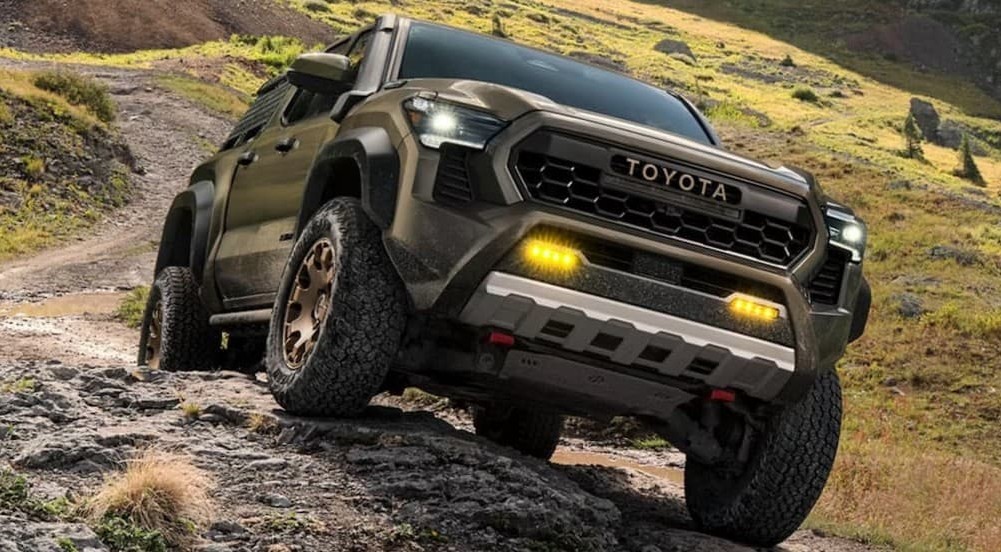
The Tacoma and Hilux aren’t necessarily better or worse than the other. It’s two approaches based on different audiences. With the exception of the GR Sport, the Hilux focuses on utility, and its smaller size helps it fit the narrower roads common in other countries. Toyota blends capability and comfort in the Tacoma, making it a truck you can drive seven days a week.
Unfortunately, if you’re an American who wants a Hilux, the only way is to import one. Under U.S. rules, a vehicle must be at least 25 years old to be imported with no restrictions, which means it wouldn’t be much different from pre-Tacoma used trucks. Unless Toyota ever decides to create an American version of the modern Hilux, it will remain little more than a pipe dream stateside.